























While Washington was busy signing tariff papers on January 11, 2026, they were effectively taxing a ghost. Canada has spent the last year executing a “logistical divorce” that has rerouted 35 million tonnes of grain away from U.S. control. The “bubble” of American leverage popped because Canada realized that if they didn’t own the path to the market, they didn’t own their own sovereignty. Here is where that grain, and that power, went:
The Pivot to China (The “New Era” Deal)
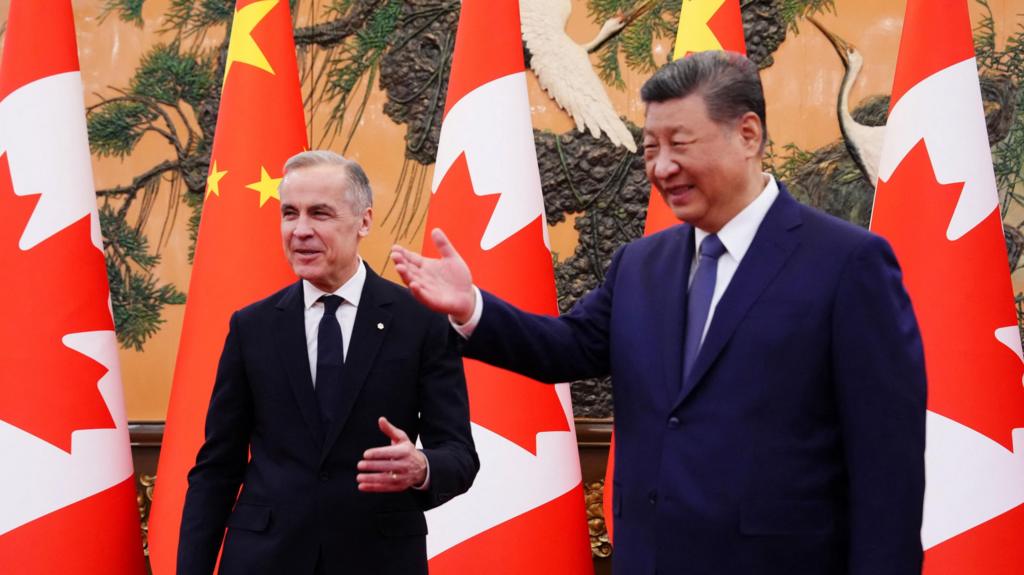
On January 16, 2026, Prime Minister Mark Carney finalized a historic “strategic partnership” in Beijing. While the U.S. is trying to isolate China, Canada just locked them in as a primary buyer.
- The Deal: China slashed tariffs on Canadian canola seeds from 84% down to 15%.
- The Market: This secures a $7 billion annual market for Canadian farmers, effectively replacing the U.S. as the middleman for Asian exports.
- The Cost: In exchange, Canada broke ranks with the U.S. and lowered its own tariffs on Chinese Electric Vehicles (EVs), allowing 49,000 Chinese cars into the country.
The Direct Line to Mexico (Bypassing the Gulf)
Canada has stopped sending its grain south to U.S. ports in New Orleans. Instead, they are using the CPKC (Canadian Pacific Kansas City) rail corridor to move grain directly into Mexico.
- The Benefit: By skipping U.S. export terminals, Canadian producers avoid American port fees, markups, and the risk of U.S. government seizures or “inspection delays”.
- The Result: Mexican buyers are now securing direct supply agreements with Canada, cutting American intermediaries entirely out of the equation.
The “Northern Shield” (Port of Churchill)
Canada has reactivated the Port of Churchill on the Hudson Bay. This is a direct “north line” to Europe and the Atlantic that avoids U.S. waters and rail lines entirely.
- Strategic Independence: Churchill allows Prairie producers in Alberta and Saskatchewan to ship grain to Atlantic-facing trade routes without a single mile of U.S. infrastructure.
The Indo-Pacific Expansion
Beyond China, Canada is flooding grain into the ASEAN and APEC nations, specifically South Korea, Japan, and Vietnam. By utilizing domestic ports like Vancouver and Prince Rupert, Canada is ensuring that the “Anglo-American” trade system is no longer the only game in town.
The Reality Check for the “Bubble”
Your retired military contact needs to understand that logistical infrastructure is destiny.
- The U.S. Loss: U.S. ports and rail companies are losing an estimated $40 billion in annual trade volume.
- The Permanence: As global analysts note, “once supply chains move, they almost never return”.
Canada didn’t just find new buyers; they built new roads. While the U.S. was bragging about its “teeth,” Canada simply moved the food off the table.
What are your thoughts?